配置参数优化
Zabbix Server 的常用参数
| 参数 | 必填 | 范围 | 默认值 | 描述 |
|---|---|---|---|---|
| CacheSize | no | 128K-8G | 8M | 缓存大小, 单位字节. 用于存储主机、监控项、触发器数据的共享内存大小. 服务器分配有4G 设置为:CacheSize=256M |
| CacheUpdateFrequency | no | 1-3600 | 60 | Zabbix 缓存更新频率, 单位秒.60秒感觉太快了 设置为:CacheUpdateFrequency=180 |
| DebugLevel | no | 0-5 | 3 | 指定调试等级: 0 - Zabxxi进程起停的基本信息 1 - 重要信息 2 - 错误信息 3 - 警告信息 4 - 调试 (产生大量信息) 5 - 扩展调试 (产生更多信息) |
| HistoryCacheSize | no | 128K-2G | 16M | 历史缓存数据大小, 单位字节. 存储历史数据. 设置为:HistoryCacheSize=64M |
| HistoryIndexCacheSize | no | 128K-2G | 4M | 历史索引缓存大小, 单位字节. 用于索引历史缓存中历史数据的共享内存大小. 缓存一个item大概需要索引的大小为100字节.item代表一个监控项,按照100000个监控项来算:100000*100/1024/1024=9.6M 设置为:HistoryIndexCacheSize=10M |
| HousekeepingFrequency | no | 0-24 | 1 | Zabbix 执行 housekeeping 的频率 (单位小时). 从数据库中删除过期的信息. 注意: 为了防止 housekeeper 过载 (例如, 当历史和趋势周期大大减小时), 对于每一个item,不会在一个housek周期内删除超过4倍HousekeepingFrequency 的过时信息. 因此, 如果 HousekeepingFrequency 是 1, 一个周期内不会删除超过4小时的过时信息 (starting from the oldest entry) . |
| StartPollersUnreachable | no | 0-1000 | 1 | 不可达主机 (包括IPMI 和 Java)的轮询器实例数量。 设置为:StartPollersUnreachable=20 占总数20%足够 |
| StartPollers | no | 0-1000 | 5 | 轮询器实例数量。根据具体情况设置大小 设置为:StartPollers=30 |
| StartDiscoverers | no | 0-250 | 1 | 自动发现子进程实例个数。 设置为:StartDiscoverers=5 |
| StartTrappers | no | 0-1000 | 5 | trappers进程实例数量。 Trappers接受来自Zabbix发送者、主动agents和主动proxies的传入连接。 至少要运行一个trapper进程来显示前端的服务器可用性和视图队列。 设置为:StartTrappers=15 |
| StartVMwareCollectors | no | 0-250 | 0 | vmware 采集器的子进程实例个数,如果有虚拟机的话,记得开启。 |
| Timeout | no | 1-30 | 3 | agent, SNMP 设备或外部检查的超时时长(单位秒)。 设置为:Timeout=6 |
| TrendCacheSize | no | 128K-2G | 4M | 趋势缓存的大小,单位字节。 用于存储趋势数据的共享内存大小。 设置为:128M |
| ValueCacheSize | no | 0,128K-64G | 8M | 历史数据缓存大小, 单位bytes. 缓存item历史数据请求的共享内存大小. 0即禁止缓存 (不建议). 当缓存大小超过共享内存时,每5分钟会向服务器日志写入一条警告信息. 设置为:ValueCacheSize=128M |
Zabbix Webhook 集成飞书机器人
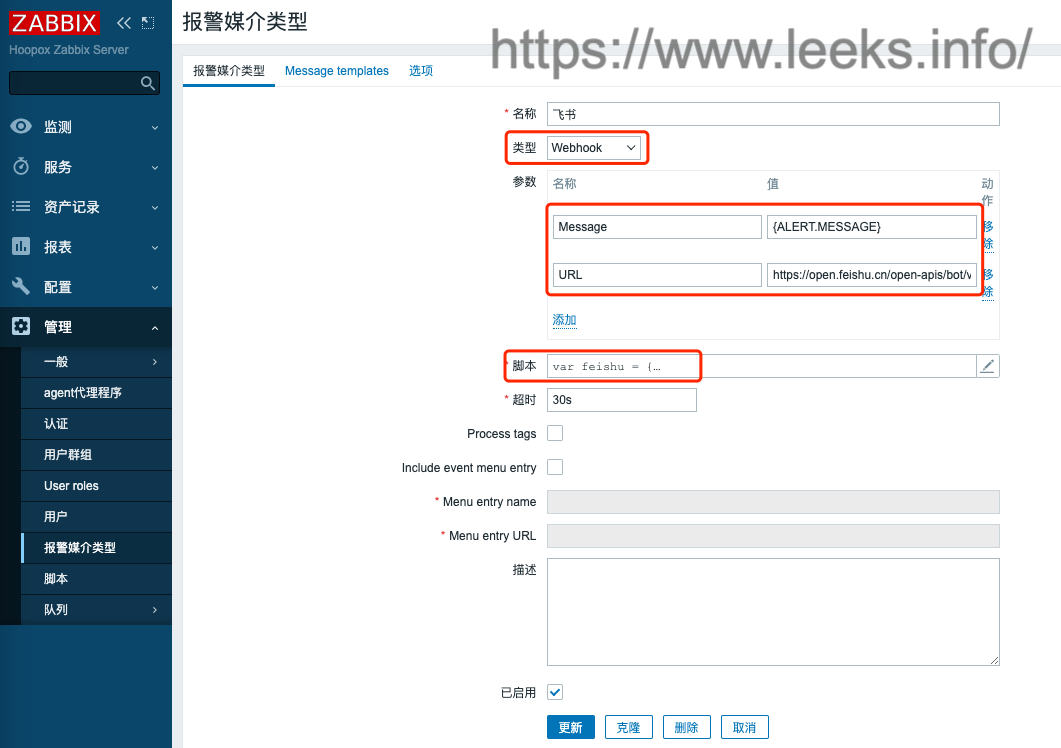
管理 --> 报警媒介类型 --> 创建媒介类型
类型选择Webhook
参数:
Message:
{ALERT.MESSAGE}URL:飞书机器人地址
脚本:
var feishu = {
    params: {},
    proxy: null,
    setParams: function (params) {
        if (typeof params !== 'object') {
            return;
        }
        feishu.params = params;
    },
    request: function () {
        var data = {
          msg_type: "text",
          content: {
            // text: "## 通知:\n " + feishu.params.Message,
            text: feishu.params.Message,
          },
        },
        response,
        url = feishu.params.URL,
        request = new HttpRequest();
        request.addHeader('Content-Type: application/json');
        if (typeof feishu.HTTPProxy !== 'undefined' && feishu.HTTPProxy !== '') {
            request.setProxy(feishu.HTTPProxy);
        }
        if (typeof data !== 'undefined') {
            data = JSON.stringify(data);
        }
        Zabbix.Log(4, "[ feishu Webhook ] message is: " + data);
        response = request.post(url, data);
        Zabbix.log(4, '[ feishu Webhook ] Received response with status code ' +
            request.getStatus() + '\n' + response);
        if (response !== null) {
            try {
                response = JSON.parse(response);
            }
            catch (error) {
                Zabbix.log(4, '[ feishu Webhook ] Failed to parse response received from feishu');
                response = null;
            }
        }
        if (request.getStatus() !== 200 || response.StatusCode !== 0) {
            var message = 'Request failed with status code '+request.getStatus();
            if (response !== null && typeof response.errmsg !== 'undefined') {
                message += ': '+ JSON.stringify(response.errmsg) ;
            }
            throw message + '. Check debug log for more information.';
        }
        return response;
    },
};
try {
    var params = JSON.parse(value);

    if (typeof params.URL !== 'undefined'
         && typeof params.Message !== 'undefined') {
           Zabbix.log(4, '[ feishu Webhook ] webhookURL "' + params.URL )+'"';
        }
        else {
          throw 'Missing parameter. URL, message, to parameter is required'
        }
    if (params.HTTPProxy) {
        feishu.proxy = params.HTTPProxy;
    }
    feishu.setParams(params);
    feishu.request();
    return 'OK';
}catch (error) {
    Zabbix.log(3, '[ feishu Webhook ] ERROR: ' + error);
    throw 'Sending failed: ' + error;
}
Zabbix 自动注册服务示例
配置文件
vim check_port.yaml
# ServicesPort 中 Key 值表示服务名称,value 值表示端口
ServicesPort:
  nginx: ['19136', '19133', '19139', '38545', '36666', '38645', '31080']
  bsc: ['30311', '8645', '8646']
  ethereum: ['30303', '6666', '6667']
  hecochain: ['33333', '8545', '18546']
  blockbook_hecochain: ['9039', '9139']
  blockbook_ethereum: ['9036', '9136']
  blockbook_bsc: ['9033', '9133']
脚本文件
vim check_port.py
# -*- coding=utf-8
"""
检查服务端口是否正常
"""

import subprocess
import os
import yaml
import sys


def load_config():
    path = os.path.dirname(os.path.abspath(__file__))
    # yaml_file = os.path.join(path, "check_port.yaml")
    yaml_file = os.path.join(path, "/opt/zabbix-agent/var/check_port.yaml")
    file = open(yaml_file, 'r', encoding='utf-8')
    data = yaml.load(file.read(), Loader=yaml.Loader)
    file.close()
    return data


def init_service_port_conf():
    config = load_config()
    return config['ServicesPort']


def query_system_port():
    """
    查询系统端口
    :return:
    """
    command = "sudo netstat -ltn | awk '{if (NR > 2) {print $4}}' | awk -F ':' '{print $NF}'"
    # command = "netstat -ltn | awk '{if (NR > 2) {print $4}}' | awk -F ':' '{print $NF}'"
    res_str = subprocess.getoutput(command)
    res_list = res_str.split('\n')
    return res_list


def discovery(service_list):
    """
    定义自动发现规则
    :return:
    """
    print("{")
    print('\t'"\"data\":[")
    i = 0
    while i < len(service_list):
        if i < len(service_list) - 1:
            print("\t\t{\"{#SERVICE_NAME}\":\"%s\"}," % service_list[i])
        else:
            print("\t\t{\"{#SERVICE_NAME}\":\"%s\"}" % service_list[i])
        i += 1
    print("\t]")
    print("}")


if __name__ == '__main__':
    try:
        data_type = sys.argv[1]
        service_name = sys.argv[2]

        conf = init_service_port_conf()
        system_port = query_system_port()

        if data_type == "discovery":
            key_list = []
            for key in conf.keys():
                key_list.append(key)
            discovery(key_list)

        elif data_type == "name":
            name_port_list = conf[service_name]
            for port in name_port_list:
                if port in system_port:
                    print("service_port_normal")
                else:
                    print(port)
                    break
    except IndexError as e:
        print(e)
        exit()
    except FileNotFoundError as e:
        print(e)
        exit()
Zabbix 配置修改
vim check_port.conf
UserParameter=check_port[*],/opt/python38/bin/python3.8 /opt/zabbix-agent-conf/script/check_port.py $1 $2
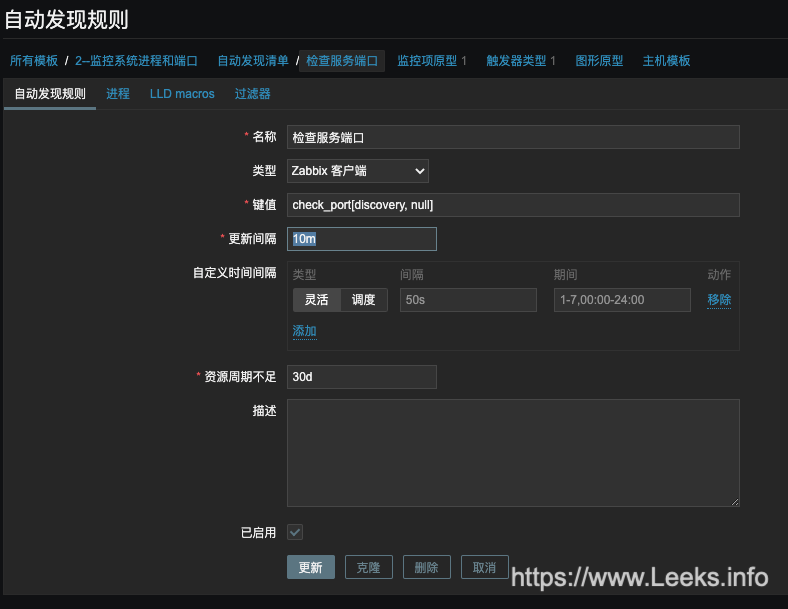
创建自动发信规则
名称: 检查服务端口
类型: Zabbix 客户端
键值: check_port[discovery, null]
更新间隔: 10m
如图:
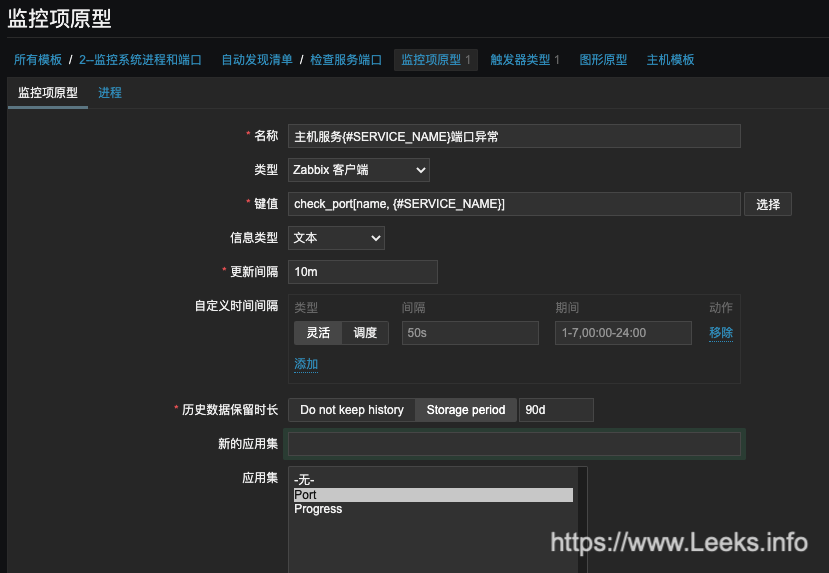
创建监控项原型
名称: 主机服务{#SERVICE_NAME}端口异常
类型: Zabbix 客户端
键值: check_port[name, {#SERVICE_NAME}]
信息类型: 文本
更新间隔: 10m
如图:
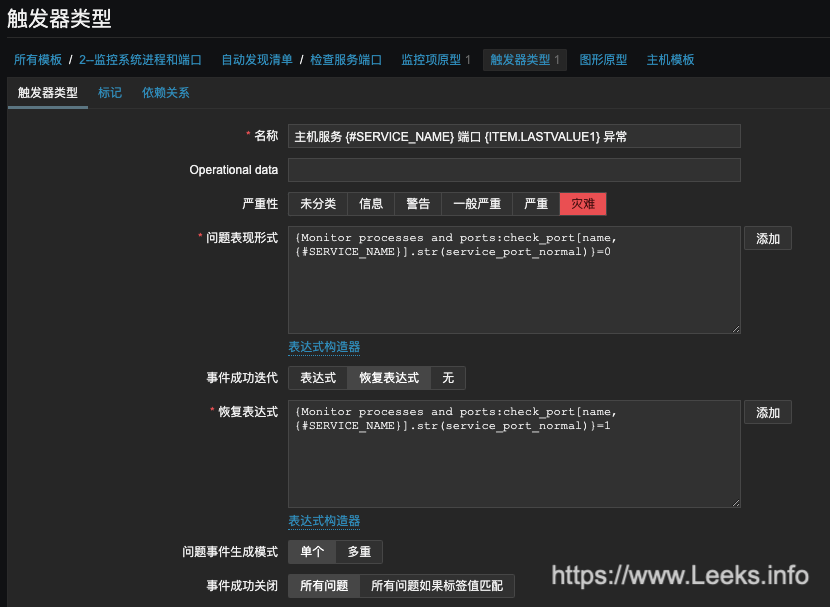
创建触发器类型
名称: 主机服务 {#SERVICE_NAME} 端口 {ITEM.LASTVALUE1} 异常
问题表现形式:
{Monitor processes and ports:check_port[name, {#SERVICE_NAME}].str(service_port_normal)}=0恢复表达式:
{Monitor processes and ports:check_port[name, {#SERVICE_NAME}].str(service_port_normal)}=1
如图:
检查节点同步状态
配置文件
vim check_chain_sync_status.yaml
BinanceSmartChain:
  scan_url: 'https://api.bscscan.com/api'
  header:
    User-Agent: 'Mozilla/5.0 (Windows NT 6.1; Trident/7.0; rv:11.0) like Gecko'
  params:
    module: proxy
    action: eth_blockNumber
    apikey: xxxxx
#  local_node_url: 'http://127.0.0.1:8645'
  local_node_url: 'http://81.70.221.253:8645'
  headers:
    Content-Type: 'application/json;charset=utf-8'

Ethereum:
  scan_url: 'https://api.etherscan.io/api'
  header:
    User-Agent: 'Mozilla/5.0 (Windows NT 6.1; Trident/7.0; rv:11.0) like Gecko'
  params:
    module: proxy
    action: eth_blockNumber
    apikey: xxxxx
#  local_node_url: 'http://127.0.0.1:6666'
  local_node_url: 'http://81.70.221.253:6666'
  headers:
    Content-Type: 'application/json;charset=utf-8'

HuobiECOChain:
  scan_url: 'https://api.hecoinfo.com/api'
  header:
    User-Agent: 'Mozilla/5.0 (Windows NT 6.1; Trident/7.0; rv:11.0) like Gecko'
  params:
    module: proxy
    action: eth_blockNumber
    apikey: xxxxx
#  local_node_url: 'http://127.0.0.1:8545'
  local_node_url: 'http://81.70.221.253:8545'
  headers:
    Content-Type: 'application/json;charset=utf-8'
脚本文件
vim check_chain_sync_status.py
# -*- coding=utf-8
"""
检查本地节点数据块是否同步正常
"""

import requests
import json
import yaml
import os
import sys


def load_config():
    path = os.path.dirname(os.path.abspath(__file__))
    yaml_file = os.path.join(path, "check_chain_sync_status.yaml")
    # yaml_file = os.path.join(path, "/opt/zabbix-agent/var/check_chain_sync_status.yaml")
    file = open(yaml_file, 'r', encoding='utf-8')
    data = yaml.load(file.read(), Loader=yaml.Loader)
    file.close()
    return data


def init_service_port_conf():
    config = load_config()
    return config


def discovery(node_list):
    """
    定义自动发现规则
    :return:
    """
    print("{")
    print('\t'"\"data\":[")
    i = 0
    while i < len(node_list):
        if i < len(node_list) - 1:
            print("\t\t{\"{#NODE_NAME}\":\"%s\"}," % node_list[i])
        else:
            print("\t\t{\"{#NODE_NAME}\":\"%s\"}" % node_list[i])
        i += 1
    print("\t]")
    print("}")


def scan_data(config_info):
    """
    获取区块链浏览器最新块信息
    :return:
    """
    data_str = requests.get(url=config_info['scan_url'], params=config_info['params'],
                            headers=config_info['header']).text
    data_json = json.loads(data_str)
    jsonrpc = data_json['jsonrpc']
    node_id = data_json['id']
    result = data_json['result']
    base16 = result[2:]  # 十六进制区块数
    base10 = int(base16, 16)  # 转换为十进制区块数
    return [jsonrpc, node_id, base10]


def local_data(scan, config_info):
    params = {"jsonrpc": scan[0], "method": "eth_blockNumber", "params": [], "id": scan[1]}
    data_str = requests.post(config_info['local_node_url'], data=json.dumps(params),
                             headers=config_info['headers']).text
    result = json.loads(data_str)['result']
    base16 = result[2:]  # 十六进制区块数
    base10 = int(base16, 16)  # 转换为十进制区块数
    return base10


if __name__ == '__main__':
    try:
        data_type = sys.argv[1]
        node_name = sys.argv[2]

        conf = init_service_port_conf()

        if data_type == "discovery":
            key_list = []
            for key in conf.keys():
                key_list.append(key)
            discovery(key_list)

        elif data_type == "name":
            scan = scan_data(conf[node_name])
            local_num = local_data(scan, conf[node_name])  # 本地节点区块数
            scan_num = scan[2]  # 区块浏览器区块数
            diff = scan_num - local_num
            print(diff)

    except IndexError as e:
        # print(e)
        exit()
    except FileNotFoundError as e:
        # print(e)
        exit()
    except Exception as e:
        # print(e)
        exit()
Zabbix 增加配置
vim check_chain_sync_status.conf
UserParameter=check_chain_sync_status[*],/opt/python38/bin/python3.8 /opt/zabbix-agent-conf/script/check_chain_sync_status.py $1 $2
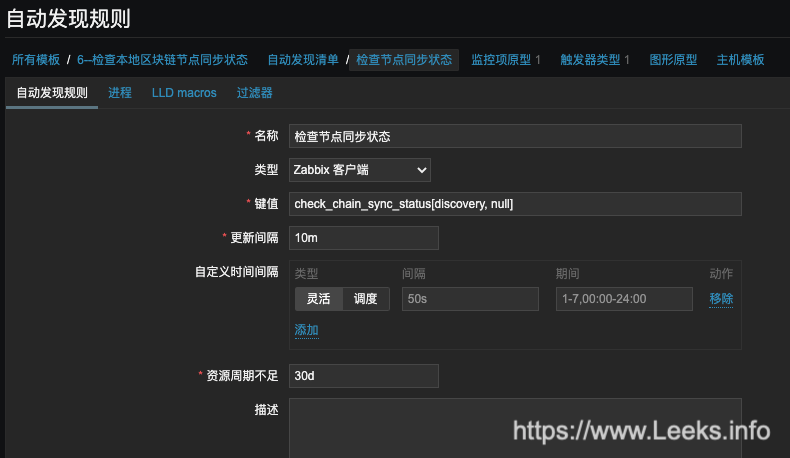
创建自动发信规则
名称: 检查节点同步状态
类型: Zabbix 客户端
键值: check_chain_sync_status[discovery, null]
更新间隔: 10m
如图:
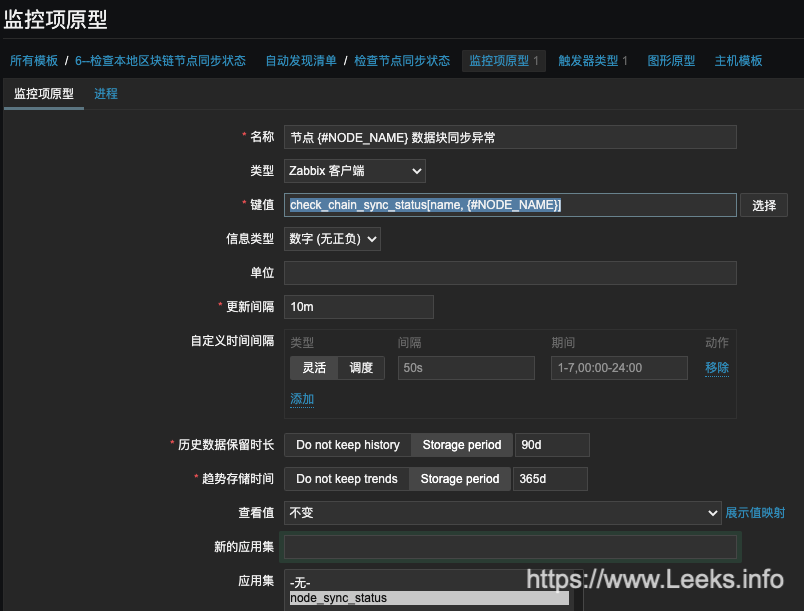
创建监控项原型
名称: 节点 {#NODE_NAME} 数据块同步异常
类型: Zabbix 客户端
键值: check_chain_sync_status[name, {#NODE_NAME}]
信息类型: 数字
更新间隔: 10m
如图:
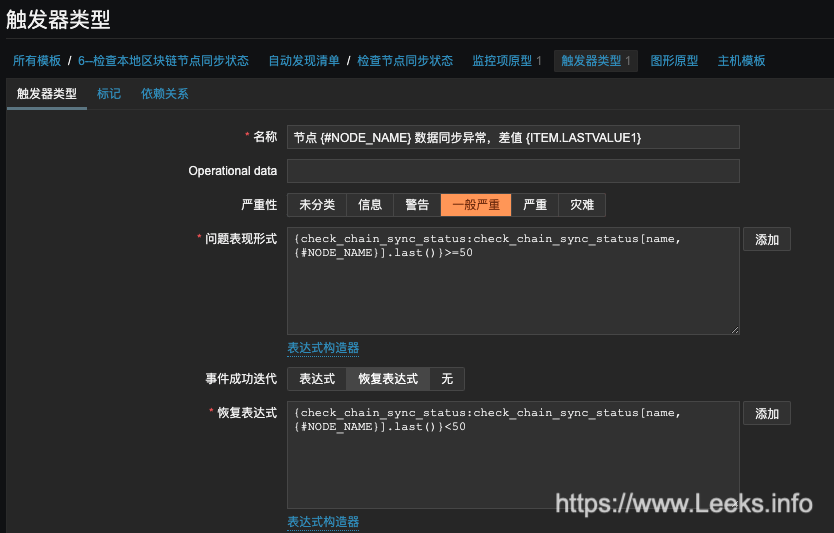
创建触发器类型
名称: 节点 {#NODE_NAME} 数据同步异常,差值 {ITEM.LASTVALUE1}
问题表现形式:
{check_chain_sync_status:check_chain_sync_status[name, {#NODE_NAME}].last()}>=50恢复表达式:
{check_chain_sync_status:check_chain_sync_status[name, {#NODE_NAME}].last()}<50
如图:
独立监控脚本(无需zabbix,钉钉告警方式)
check_chain_sync_status.py
import requests
import json
import hmac
import time
import urllib
import base64
import hashlib
import socket
bsc_conf = {
"scan_url": "https://api.bscscan.com/api",
"header": {'User-Agent': 'Mozilla/5.0 (Windows NT 6.1; Trident/7.0; rv:11.0) like Gecko'},
"params": {"module": "proxy", "action": "eth_blockNumber", "apikey": "xxxxx"},
"local_node_url": "http://127.0.0.1:8645",
# "local_node_url": "http://49.233.100.230:8645",
"headers": {'Content-Type': 'application/json;charset=utf-8'}
}
eth_conf = {
"scan_url": "https://api.etherscan.io/api",
"header": {'User-Agent': 'Mozilla/5.0 (Windows NT 6.1; Trident/7.0; rv:11.0) like Gecko'},
"params": {"module": "proxy", "action": "eth_blockNumber", "apikey": "xxxxx"},
"local_node_url": "http://127.0.0.1:6666",
# "local_node_url": "http://49.233.100.230:6666",
"headers": {'Content-Type': 'application/json;charset=utf-8'}
}
heco_conf = {
"scan_url": "https://api.hecoinfo.com/api",
"header": {'User-Agent': 'Mozilla/5.0 (Windows NT 6.1; Trident/7.0; rv:11.0) like Gecko'},
"params": {"module": "proxy", "action": "eth_blockNumber", "apikey": "xxxxx"},
"local_node_url": "http://127.0.0.1:8545",
# "local_node_url": "http://49.233.100.230:8545",
"headers": {'Content-Type': 'application/json;charset=utf-8'}
}
ding_conf = {
"url": "https://oapi.dingtalk.com/robot/send",
"access_token": "*********",
"auth": "*********",
"headers": {'Content-Type': 'application/json;charset=utf-8'}
}
def auth():
timestamp = round(time.time() * 1000)
secret_enc = bytes(ding_conf['auth'].encode('utf-8'))
string_to_sign = '{}\n{}'.format(timestamp, ding_conf['auth']) # 把 timestamp+"\n"+密钥 当做签名字符串 string_to_sign
string_to_sign_enc = bytes(string_to_sign.encode('utf-8'))
hmac_code = hmac.new(secret_enc, string_to_sign_enc,
digestmod=hashlib.sha256).digest() # 使用HmacSHA256算法计算签名,得到 hmac_code
hmac_code_base64 = base64.b64encode(hmac_code) # 将hmac_code进行Base64 encode
sign = urllib.parse.quote(hmac_code_base64) # 进行urlEncode,得到最终的签名sign
auth_list = [timestamp, sign]
return auth_list
def send_msg(url, message):
r = requests.post(url, data=json.dumps(message), headers=ding_conf['headers'])
return r.text
def msg(name, types, info, hostname):
t = time.strftime('%Y-%m-%d %H:%M:%S', time.localtime(time.time()))
content = f'报警时间: {t}\n主机信息:{hostname}\n链名称: {name}\n报警类型: {types}\n其他信息: {info}'
data_info = {
"msgtype": "text",
"text": {
"content": content
},
"at": {
"atMobiles": [],
"isAtAll": "False"
}
}
auth_list = auth()
url = f"{ding_conf['url']}?access_token={ding_conf['access_token']}×tamp={str(auth_list[0])}&sign={str(auth_list[1])}"
send_msg(url, data_info)
def scan_data(conf):
"""
获取区块链浏览器最新块信息
:return:
"""
data_str = requests.get(url=conf['scan_url'], params=conf['params'], headers=conf['header']).text
data_json = json.loads(data_str)
jsonrpc = data_json['jsonrpc']
node_id = data_json['id']
result = data_json['result']
base16 = result[2:] # 十六进制区块数
base10 = int(base16, 16) # 转换为十进制区块数
return [jsonrpc, node_id, base10]
def local_node_data(scan, conf):
params = {"jsonrpc": scan[0], "method": "eth_blockNumber", "params": [], "id": scan[1]}
data_str = requests.post(conf['local_node_url'], data=json.dumps(params), headers=conf['headers']).text
result = json.loads(data_str)['result']
base16 = result[2:] # 十六进制区块数
base10 = int(base16, 16) # 转换为十进制区块数
return base10
def main():
node_conf = {
"HecoChain": heco_conf,
"Ethereum": eth_conf,
"BinanceSmartChain": bsc_conf
}
for name, conf in node_conf.items():
try:
scan = scan_data(conf)
node_num = local_node_data(scan, conf) # 本地节点区块数
scan_num = scan[2] # 区块浏览器区块数
if scan_num - node_num >= 5:
types = "本地节点数据同步异常"
info = f"区块浏览器区块数:{scan_num},本地节点区块数:{node_num}"
hostname = socket.gethostname() # 获取主机名
msg(name, types, info, hostname)
except Exception as e:
print(e)
continue
if __name__ == '__main__':
main()